
The climate challenge: Need and models of collaboration in the Asian context
Supported by
The climate challenge in Asia-Pacific
Climate change poses a disproportionately large threat to livelihoods in Asia-Pacific. The region had its warmest year on record in 2020, with the mean temperature 1.39°C above the average for 1981–2010 and the summer monsoons being unusually active1. Further, between 2000 and 2017, natural disasters in the region caused damages worth US$149.27 billion2. Millions of homes continue to be at risk of displacement due to inundation of land due to a rise in sea levels. If this trajectory persists, rising temperatures and humidity will likely lead to a substantial loss in outdoor working hours and put between US$2.8 trillion–4.7 trillion of GDP in Asia-Pacific at risk3.

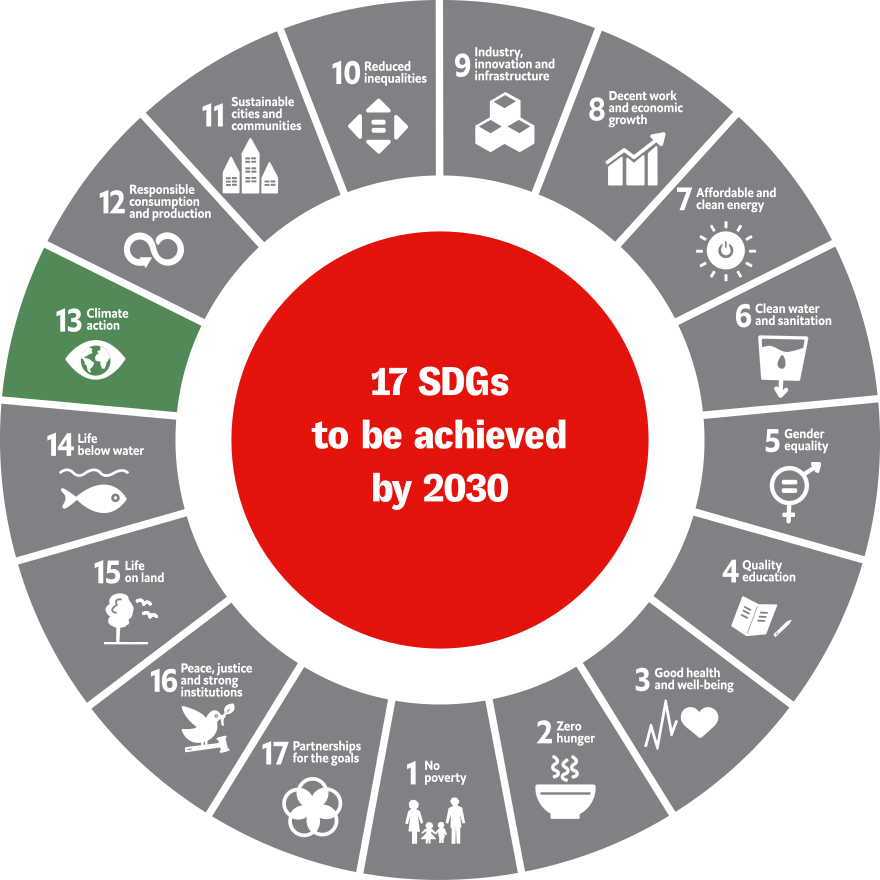
The need is especially urgent considering that one of the two Sustainable Development Goals (SDG) that the region is regressing in is “SGD 13: Climate Action”4. Economist Impact analysis5 based on data from the Sustainable Development Report 2021 shows that Asia-Pacific experienced an average decrease of 0.37 percentage point in the index score for SDG13: Climate Action from 2015 to 20216. This is mainly driven by poor performance in emissions reduction.
From 2015 to 2019 (the year of latest available data), 16 of the 20 countries saw an increase in per capita CO₂ emissions from fossil fuel combustion and cement production, bringing the average up by 0.1 ton per capita.
Collaboration pathways for climate mitigation
Multifaceted problems arising from climate change require a comprehensive approach based on the expertise of a range of stakeholders.

Economist Impact research highlights the collaboration principle—that is, collaboration is the best means to achieve systems change that addresses the root causes of problems—as one of the key principles to maximise the impact of social investment.
The research finds that the severity and complexity of issues like climate change call for strong multistakeholder collaboration, as such issues involve actors at all levels of influence—multilaterals, governments, private companies, and philanthropies. Social investors echo this. Sugandhi Matta of ABC Impact says, "I anticipate that like-minded investors can come up with platforms to solve certain problems. For example, to address water-related issues in Indonesia, you can create a platform where investors take different levels of the equity or capital structure". Further, when asked about the role of the private sector in the mitigation of the effects of climate change, Joshua Agusta of Indonesia Impact Fund says, "private companies have the speed and agility that the public sector sometimes lacks, and this enables them to tackle issues the government can’t address in time. For example, air quality is an issue but the government might not be able to deal with it because a) the solution is longer-term than the tenure of the officials, and b) they have bigger problems to worry about".

To bring these different stakeholders together, Economist Impact research identifies investor platforms as a key pathway for collaboration.
These platforms could also facilitate policy advocacy and convergence on disclosure standards and reporting. The Asia Investor Group on Climate Change (AIGCC) is one such platform. AIGCC represents the perspective of the Asian investor towards evolving global discussions on climate change and the transition to a net-zero emissions economy. Its members belong to 11 different markets in Asia-Pacific and internationally, and include asset owners and managers with a combined assets under management (AUM) of over US$35.8 trillion. With a strong international profile, the AIGCC network also engages with government pension and sovereign wealth funds, family offices, and endowments. A recent example of AIGCC’s work in facilitating international collaboration is their ongoing engagement in Japan’s energy transition plans. Along with its partners, AIGCC is facilitating policy engagement with domestic and international investors, corporates, utilities, policymakers, and civil society organisations to help formulate a reliable and actionable transition plan backed by robust policy mechanisms as the country phases out coal7.

Another example is the India Climate Collaborative (ICC). "ICC is a platform to drive collaboration and coordinated action within the climate space by connecting grant capital with impactful climate solutions to fill key gaps in the ecosystem", says Shloka Nath, Acting CEO of ICC. According to her, one example of such an effort is ICC’s collaboration Council on Energy, Environment, and Water (CEEW) to build a Climate Risk Atlas (CRA) for India. With the ICC's support and efforts for pool funding, CEEW is creating a mapping of climate risks in India at a district level, which is likely to play a critical role in building resilience to the impacts of climate change by informing interventions like climate-proof infrastructure. Furthermore, the platform also integrates the work of local civil society organisations, thereby providing them with an opportunity to scale. Highlighting the work these organisations do on the ground is attracting venture capital (VC) funding, which is a crucial aspect in climate action, says Shloka.
Mobilising private finance through blended financing
models is another collaboration pathway.

New Forests’ Tropical Asia Forest Fund (TAFF) is an example of a climate fund that uses blended finance. The TAFF is the first sustainable forestry fund for institutional investors in Asia and focuses on sustainable plantation forest management. It aims to provide viable forestry investment pathways in Southeast Asia. The fund has invested directly in companies in Laos, Malaysia, and Indonesia that are focused on sustainable plantation forestry and natural rubber production on over 150,000 hectares of land. The fund was able to create market-rate forestry returns while generating environmental and social impact through sustainable forest management, land restoration, conservation, reduction of CO2 emissions, and rural job creation. Owing to the success of the first fund, a second fund (TAFF2) was launched with a blended finance structure. "The blended finance structure will enable TAFF2 to integrate investment in impact activities focused on climate action, community engagement and livelihoods, and biodiversity conservation", says Lauren Stewart, Head of Communications, Impact and Advocacy Group at New Forests Asset Management Pty Ltd.

The need to expand collaboration efforts is immediate
While there have been various collaboration efforts in Asia-Pacific to meet the goals of the Paris Agreement8, these efforts need to expand much more at a regional level.

In a region that had legacy areas (like education, for instance) and traditional forms of philanthropy, areas like climate and strategic philanthropy are at a very nascent stage. For the new generation, climate is a generational issue and they understand the need for more systemic change.
-Shloka Nath, ICC
Considering that the window to meet the United Nations’ climate targets is rapidly vanishing9, substantial progress will only be achieved by collectively taking serious steps in the region.
- The World Meteorological Organisation.
- South Asia needs to act as one to fight climate change.
- Climate Risk and Response in Asia https://www.mckinsey.com/business-functions/sustainability/our-insights/climate-risk-and-response-in-asia
- United Nations ESCAP’s ‘Asia and the Pacific SDG Progress Report 2021’
- Sustainable Development Report 2021 data.
- An average decrease of 0.37 percentage points in the index score for SDG 13: Climate Action.
- In May 2022, AIGCC hosted an official ‘side event’ to Responsible Investor Japan 2022. The event included the participation of domestic and international investors, corporates, utilities, policymakers, and civil society organisations in Japan in a discussion on Japan’s energy transition plans.
- The Paris Agreement is a legally binding international treaty on climate change.Its goal is to limit global warming to well below 2, preferably to 1.5 degrees Celsius, compared to pre-industrial levels.
- A new IPCC report says the window to meet UN climate targets is vanishing
Other articles

Investing in healthcare: Technology as the key to scalable impact
Asia-Pacific is falling behind on progress in the health SDG. Investing in technology can help countries get back on track by creating scalable impact with commercially viable models.
Read article



Addressing inclusion in livelihood investments
As the pandemic takes its toll on the economy, inclusion in livelihood investments is more critical than ever.It does not have to come at the expense of financial sustainability, as examples from Asia-Pacific show.
Read article

Intentionality in gender investments
Gender equality calls for investments where benefits for women are not just an unintentional output. Case studies show why Asia-Pacific needs such investments, and how to make the most of them.
Read article
