

Addressing inclusion in livelihood investments
Supported by
How inclusive are livelihood opportunities in Asia-Pacific?
In Asia-Pacific, there are fewer livelihood opportunities and these are less secure for certain groups of the population, particularly women and the disabled. For individuals with disabilities over the age of 15 years, the employment-to-population ratio is only 36% compared with 61% for individuals without disabilities in both East Asia and South-east Asia”. For women with disabilities in the same regions, the ratio is even lower at 29%1. Individuals with disabilities are often not registered on employment rolls, thereby making them invisible in labour market statistics and, thus, likely to be overlooked in policy measures2. For those who are employed, up to three-fourths of them work in the informal economy. For example, in Indonesia in 2017, 65% of employed individuals with mild disabilities and 76% of employed individuals with severe disabilities were reported to be working in informal jobs3.

The relationship between poverty and disability has been considered a vicious cycle4. Poverty and lack of livelihood opportunities manifest in the form of hunger and malnutrition, limited access to education and other basic services, and social discrimination and exclusion, more so for the disabled. The covid-19 pandemic has worsened the challenge by putting the livelihoods of millions at risk in Asia-Pacific.

In 2020, the pandemic pushed 4.7 million additional people in Southeast Asia into extreme poverty5 and obliterated 9.3 million jobs in the region, thereby exacerbating the already existing inequalities in the region.
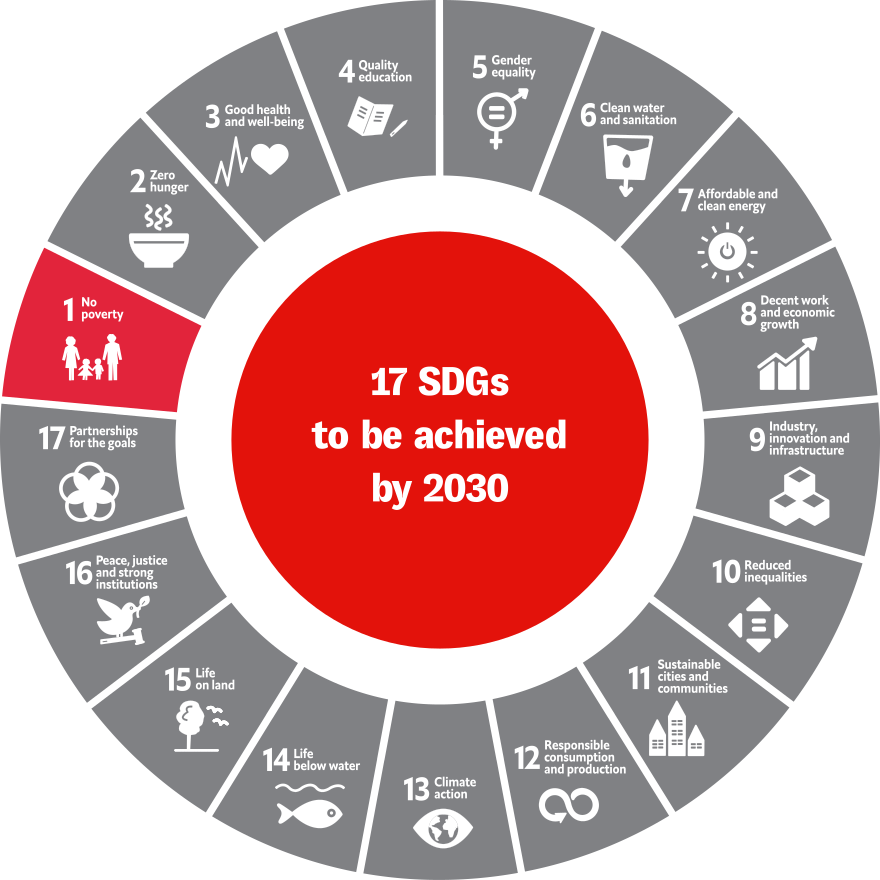
For Asia-Pacific to achieve the targets set out by the sustainable development goals (SDG) of the United Nations (UN), investment in livelihoods needs to be more targeted and inclusive.

Examples of what is working well in the region6
Enabling livelihoods for the disabled through policy support from the government and implementation by the private sector is working well in parts of Asia-Pacific.

Advanced Personnel Management (APM), Australia, is one such example that follows the collaboration principle—that is, collaboration is the best means to achieve systems change that addresses the root causes of problems, as outlined in research by Economist Impact to maximise the impact of social investments.

APM collaborates with the Government of Australia to deliver its Disability Employment Services (DES) programme which supports individuals with disabilities on their journey to sustainable employment7. Funded by the Australian government, APM provides employment support to those who are eligible, including individuals with disabilities. Of the 110 DES service providers, APM is the foremost provider in terms of locations, number of contracts, and—most importantly—participant outcomes.
Furthermore, APM assists eligible participants looking for work with workforce preparation, training in specific job skills, writing resumes, developing interview skills, and broader job search assistance. When asked about her vision for APM, Megan Wynne, the Executive Chair and Founder of APM, said, ‘Every day APM empowers people to realise their ambitions and aspirations through achieving sustainable employment and economic independence, better health and wellbeing and increased social participation. In the past twelve months across the globe we have supported 180,000 people with disability, including assisting 90,000 into sustainable employment. As we look forward, we hope to support more people globally to achieve their dreams through sustainable employment’.
APM’s success has not come at the cost of its business performance. In FY21, APM generated revenues of AUD$1 billion and made its initial public offering (IPO) on the Australian Securities Exchange in the same year. It is now active in 1000 locations in 11 countries.
Further, Quon Chocolate, a Japanese chocolate maker, is another example of how inclusion and commercial success can come hand-in-hand.

In particular, Quon’s success highlights the intersectionality principle—that is, prioritise investments that deliver multiple impacts, as outlined in research by Economist Impact to maximise the impact of social investments.
By providing decent job opportunities for the disabled and gender minority individuals, Quon is contributing towards SDG58, SDG89, and SDG1010, thereby delivering multiple impacts. 350 out of 550 staff members at Quon have disabilities. While time-consuming, the manual process involved in manufacturing high-quality, oil-free chocolate is straightforward and there is a high tolerance for errors. This implies that with training and practice, individuals with disabilities can become great chocolate makers.

Disabled workers are able to take on small-scale tasks, such as making green tea powder in small quantities from different leaves and stems. This allows fine adjustments in flavour in the green tea chocolates, which would otherwise be difficult to incorporate in a standardised production process11. In addition, Quon also makes gender minority12 employees feel at home by creating a culture in which they can express opinions easily and are accepted for who they are.

What’s next?
The examples of APM and Quon reveal that it is possible to create livelihoods for individuals with disabilities in a manner that is profitable, while creating an opportunity that did not exist earlier. In these examples, enabling inclusion does not come at the expense of financial sustainability and, in fact, contributes to financial success. While this is a good start, eliminating barriers to the participation of disabled individuals in livelihood opportunities requires more sustained and collective action across the region.
- United Nations (UN), 2018
- https://www.unescap.org/sites/default/d8files/knowledge-products/Employment_of_Persons_with_Disabilities_final_0.pdf
- ibid.
- Department for International Development (DFID), 2000.
- Asian Development Bank (ADB), 2020. Extreme poverty is defined as ‘as those living on less than US$1.90 per day’.
- For the selected themes in the articles, most cases focus on principles till the implementation stage as there was an insufficient number of compelling success stories that represent principles from the completion and post-completion stages in the literature from Asia-Pacific.
- The DES is a part of Australia’s National Disability Strategy. The National Disability Strategy is a key national policy that contributes to addressing the UN SDGs, as highlighted by the Australian
- Gender equality.
- Promote sustained, inclusive, and sustainable economic growth; full and productive employment; and decent work for all.
- Reduce inequality within and among countries.
- Kyodo News.
- Transgender employees.
Other articles

Investing in healthcare: Technology as the key to scalable impact
Asia-Pacific is falling behind on progress in the health SDG. Investing in technology can help countries get back on track by creating scalable impact with commercially viable models.
Read article



The climate challenge: Need and models of collaboration in the Asian context
Multifaceted problems arising from climate change are affecting Asia-Pacific disproportionately, and they require collaboration to solve. There are multiple pathways to do so.
Read article

Intentionality in gender investments
Gender equality calls for investments where benefits for women are not just an unintentional output. Case studies show why Asia-Pacific needs such investments, and how to make the most of them.
Read article
